

The traditional set: the foundation
You do a number of reps, rest and repeat. It’s the simplest technique and the one that should carry most of your training. All the others are variations to add effort or save time.
Superset
Two exercises back to back with no rest between them; you rest when the pair is done. The usual approach is to pair opposing muscles (biceps and triceps, chest and back), so one rests while the other works.
When to use it: when you’re short on time or want a denser workout.
Drop set
You do a set close to failure, lower the weight (roughly 20 to 30 %) and carry on without resting, repeating once or twice more.
When to use it: at the end of an isolation exercise, to squeeze a muscle. It’s very tiring: don’t use it on every set.
Cluster set
You split a set into short blocks with a very brief pause (10 to 30 seconds) between them, using the same weight. That way you keep the quality of each rep with heavy loads.
When to use it: on heavy exercises where you want more good reps with the same weight.
Rest-pause
You do a set to the limit, rest about 10 to 20 seconds and do another round with the same weight to the limit, and you can repeat it once or twice more.
When to use it: to add reps at the end of a main set without lowering the weight.
Myo-reps
One activation set close to failure (usually 12 to 20 reps), then several mini-sets of 3 to 5 reps with 10 to 20 second pauses and the same weight, until you can no longer complete those 3 to 5 reps.
When to use them: on isolation exercises when you’re short on time, to pile up lots of effective reps in a few minutes.
Comparison table
A summary to help you choose:
| Technique | What it is | Rest | Best for |
|---|---|---|---|
| Traditional | Set, rest and repeat | 1 to 3 min | Most of your workout |
| Superset | Two exercises back to back | After the pair | Saving time |
| Drop set | Lower weight without stopping | None between drops | Finishing an isolation exercise |
| Cluster | Set in short blocks | 10 to 30 s between blocks | Heavy loads |
| Rest-pause | Rounds to the limit with pauses | 10 to 20 s | Adding reps |
| Myo-reps | Activation + mini-sets | 10 to 20 s | Isolation when short on time |
Rough figures: adjust to your level. If you have an injury or a health condition, talk to a professional.
When to use them and when not to
- If you’re starting out, stick to traditional sets: advanced techniques need a base and good technique.
- Use one or two per session, usually on the last exercise for a muscle.
- Avoid them on the heaviest, most demanding exercises (squat, deadlift) unless you know what you’re doing.
- If your technique slips or you don’t recover between sessions, go back to traditional sets.
These techniques let you build up volume in less time. The evidence that they beat traditional sets at the same total volume is limited: use them for practicality, not as a magic trick.
How FierFit Gym does it
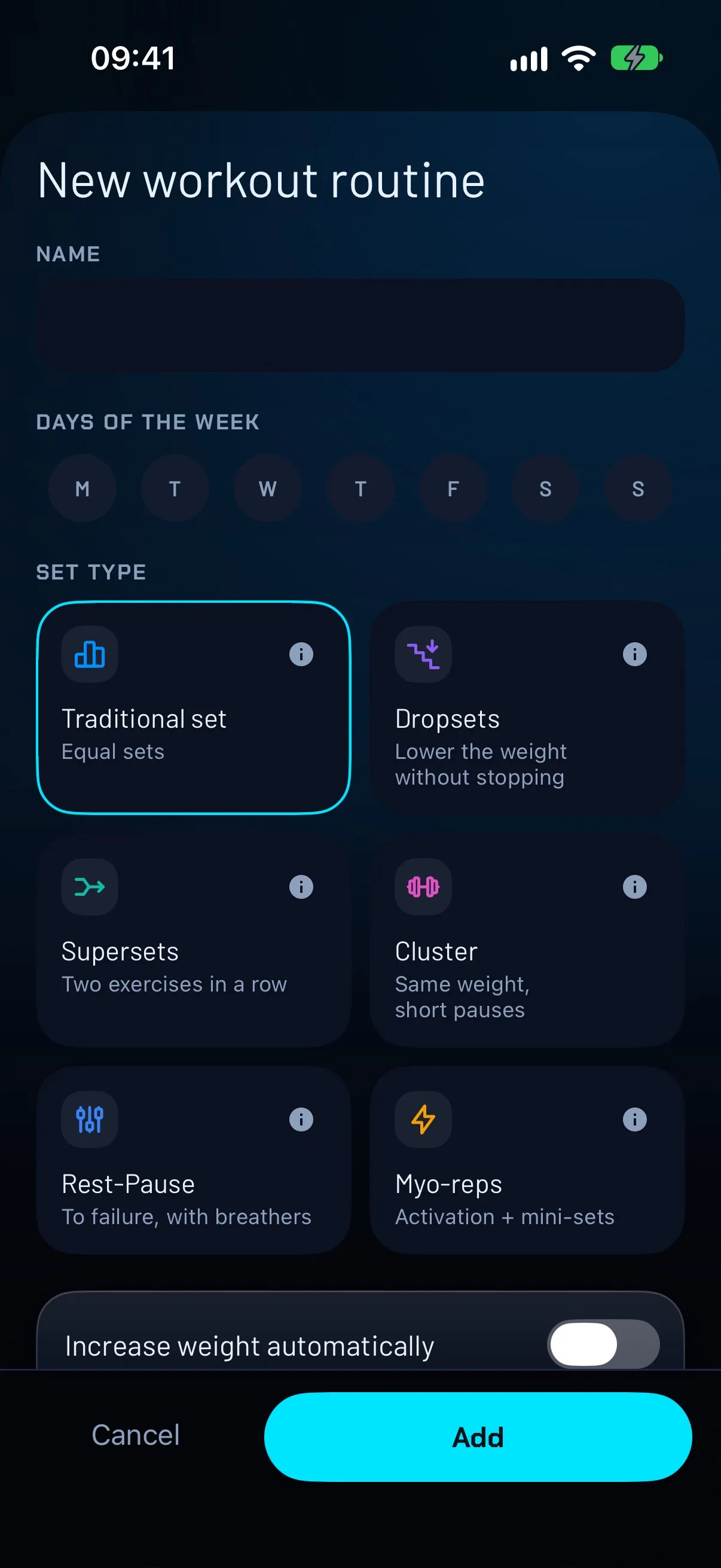
In FierFit Gym you choose the set type when you create a routine: traditional set, dropsets, supersets, cluster, rest-pause or myo-reps. Each type comes with a short description and an “i” icon that explains it.
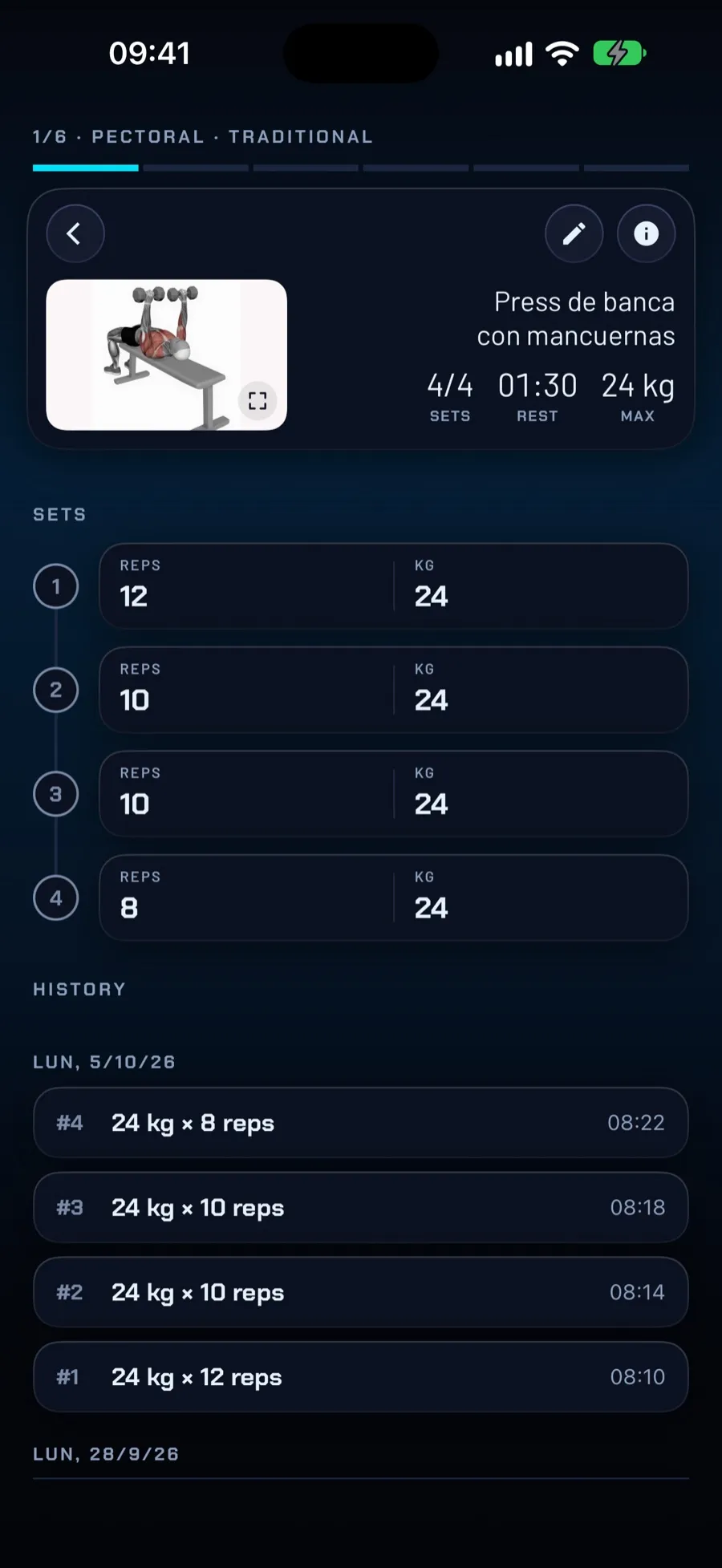
During the workout you log each set with its rest timer and, when you finish, you get the workout report.
Frequently asked questions
What is a superset?
Two exercises back to back with no rest between them. You rest when the pair is done. The most common approach is to pair opposing muscles, like biceps and triceps.
What is a drop set?
A set close to failure followed by another with less weight, with no rest between them. You repeat it once or twice.
What are myo-reps?
One activation set close to failure and then several mini-sets of 3 to 5 reps with very short pauses and the same weight.
Are they better than regular sets?
Not necessarily. They let you build up volume in less time, but the evidence that they beat traditional sets at the same total volume is limited.
Keep reading
More guides
- Beginner gym routine: 3 days a week, full body →
- Counting calories with a photo: how it works and how far to trust it →
- Gym app for Apple Watch: what you can do from your wrist →
- How to track your supplements and never miss a dose →
- When to take creatine: timing, dose and loading phase →
- How much protein per day you need for your weight and goal →